Ideas
What can ideas for steampunk games learn from brass, steam and clockwork?
Why Brass and Clockwork Suit a Strategy Game
Brass, steam and clockwork make a strong strategy setting when they do more than decorate it. In Zone77, underground survival, resource-producing fields, winding machines and a shared Great Clock connect the look to choices players make. The result is a world whose machinery feels useful, vulnerable and worth arguing about.
Make the machinery matter
Brass pipes and copper gears can establish a mood, but the setting feels more convincing when machinery has a place in the decisions. In Zone77, the Engine Hall is part of town development: upgrading it makes building faster and provides room for more workers. Every machine has a spring, and Energy can be used to finish work sooner. Those details give the industrial look a practical role.
That connection is useful inspiration for steampunk world building. Ask what a machine means to the people who rely on it. Is it a source of comfort, a tool that needs care, or a reminder that life depends on an immense contraption? A setting becomes more memorable when its devices shape everyday choices as well as its skyline.
See also: the Zone77 home page.
Let scarcity tell part of the story
An underground home gives resources a clear sense of purpose. Mines, wells and farms produce Coal, Iron, Water, Food and Gears. Workers and soldiers need Food, while storage limits how much a town can keep. These are game choices, but they also help the world feel lived in: people must tend fields, manage stores and keep the lamps and machines supplied.
A useful idea for a strategy game is to make its resources feel like parts of one place, rather than a list with no connection to the setting. Here, the player is building beneath a dead sky, in a world where a giant Engine once brought heat and light. That gives ordinary stores a little narrative weight without needing a separate story for every resource.
Give the map a shape players can read
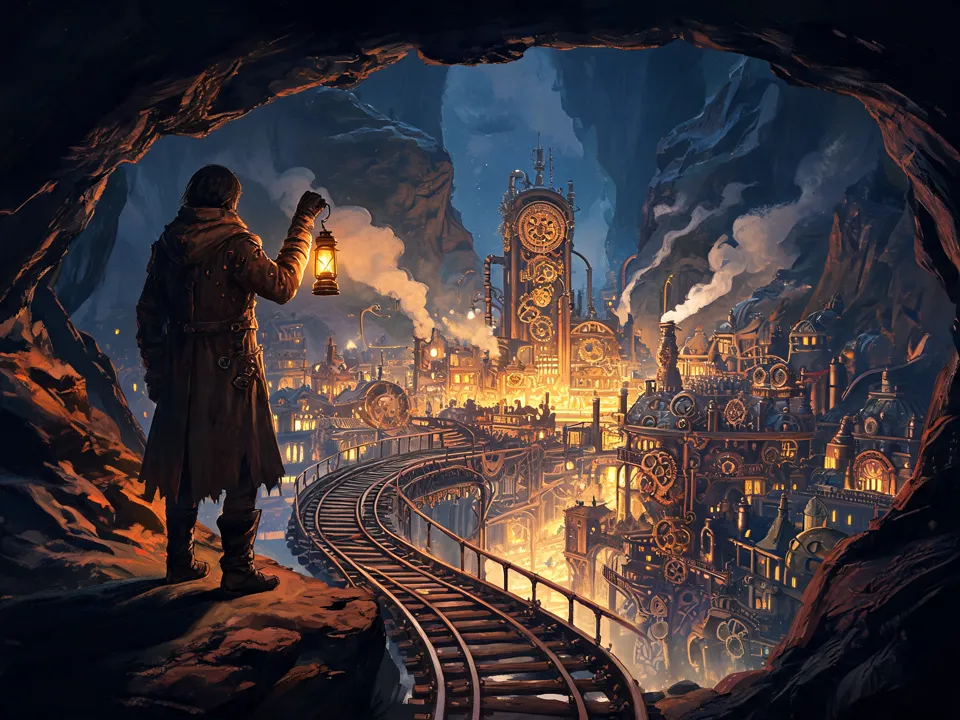
Steampunk geography can make the world feel like an engineered space. Zone77's map is a large square, with the Great Clock at its center, fields connected by tunnels and Rust camps around the map. That arrangement gives the setting a strong visual idea: the routes between places matter, and the central landmark carries meaning beyond its appearance.
When designing a world, consider what a map can suggest before a player reads a description. Tunnels can make an underground setting tangible; a central site can become a shared destination. The map does not need to explain everything. A few clear features can give players room to imagine the rest.
See also: the guide to the map.
Make the big goal belong to everyone
The most appealing clockwork in a strategy setting may be the machine everyone has a reason to care about. In Zone77, alliances race to build the Great Clock, which can start the Great Engine again. The aim ties the world's history to cooperation and competition, so the setting's central machine is also a shared purpose.
What other objects could play that role in a steampunk world: a public observatory, a failing waterworks, a railway hub? The best candidate might be something that changes how players think about the whole map, while still leaving room for alliances to pursue it together. Share your own setting ideas and questions with other readers.
See also: share your ideas on the forum.
Questions and answers
Why does clockwork suit a strategy game?
Clockwork naturally suggests systems that need resources, attention and decisions. It can make town-building choices feel like part of the setting instead of separate menus.
What makes steampunk world building feel connected?
Connect the visual style to the people and places in the world. In Zone77, underground life, resource fields, machines and the Great Clock all belong to the same setting.